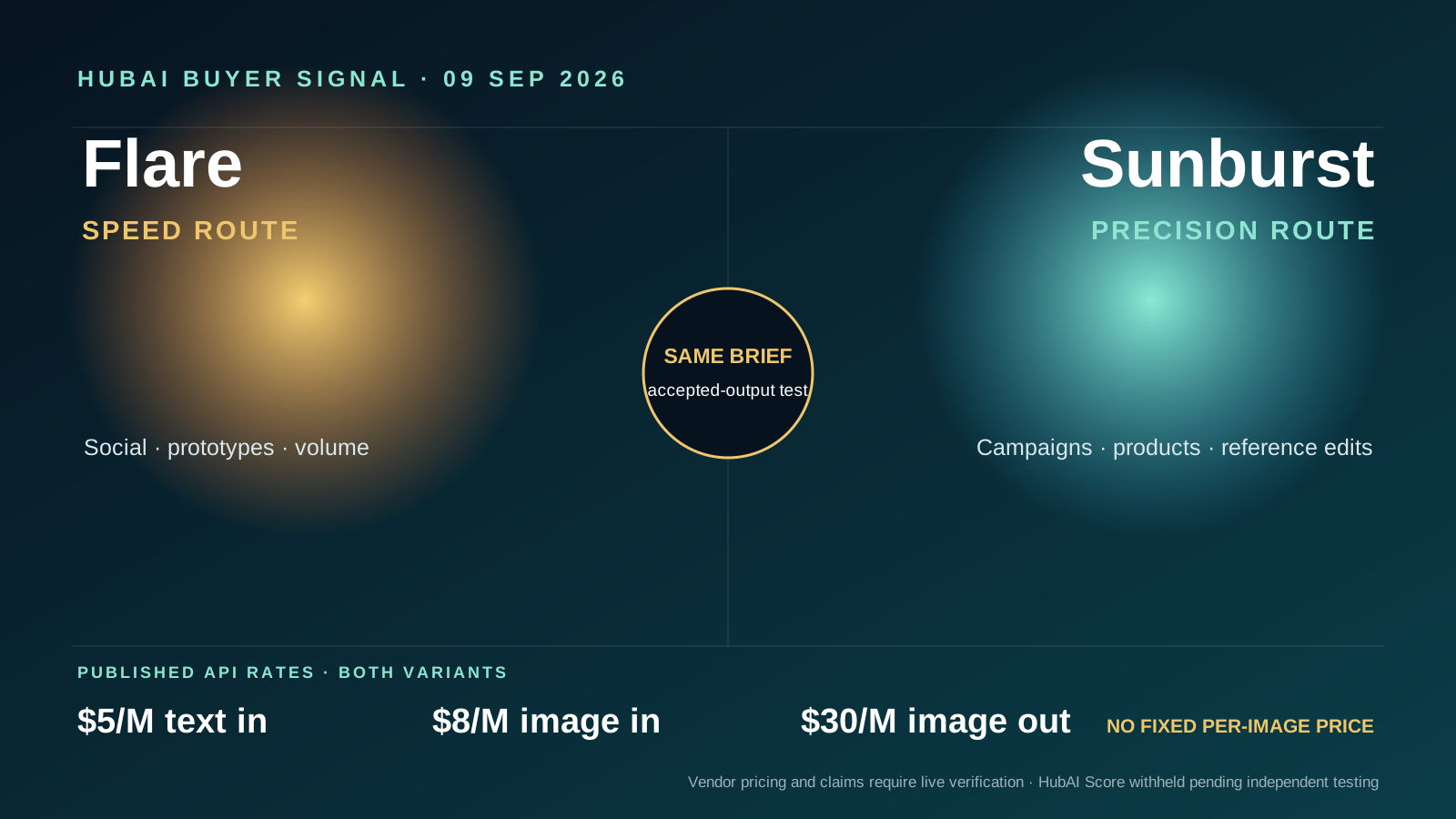
OpenAI has released ChatGPT Images 2.5 with production-focused editing and two API routes: faster Flare and quality-led Sunburst.
RELATED BUYER PROFILEReview GPT-Image-2.5 Flare pricing, fit and test statusPricing · access · strengths · limitations →CONTINUE THE DECISIONCompare Flare and Sunburst on the same production briefEvidence · workflow · next action →CONTINUE THE DECISIONReview the quality-led Sunburst profileEvidence · workflow · next action →CONTINUE THE DECISIONCalculate complete cost per accepted outputEvidence · workflow · next action →What you need to know
- GPT-Image-2.5 Flare is the speed-led route; GPT-Image-2.5 Sunburst is positioned for precision and premium output
- Both API variants list $5/M text input, $8/M image input and $30/M image output; there is no universal per-image price
- OpenAI reports latency up to 50% lower than Images 2.0, but this is a vendor claim and should be tested on the buyer's own workflow
The Images 2.5 buying brief
A production update, not only a generation upgrade
OpenAI released ChatGPT Images 2.5 on 8 September across ChatGPT, ChatGPT Work and Codex. The update is designed to preserve people, products, composition and visual identity while changing a specific part of an image. ChatGPT also adds sketch-led creation, reusable templates, comments placed on images and prompt sharing. Those workflow features matter because professional image work is usually an iterative approval process rather than a single prompt.
Flare versus Sunburst
Flare is positioned as the faster default for social assets, rapid prototyping and higher-volume applications. Sunburst is the quality-led option for campaign creative, polished product imagery and edits where precise reference preservation matters more than speed. HubAI's recommended test sequence is to establish the acceptance threshold with Sunburst, then repeat the same prompts, references, dimensions and quality settings with Flare. Move to Flare only if it continues to pass the agreed quality gate.
API pricing needs a complete-task calculation
OpenAI lists the same token rates for both variants: $5 per million text-input tokens, $1.25 per million cached text-input tokens, $8 per million image-input tokens, $2 per million cached image-input tokens and $30 per million image-output tokens. The API free tier is not supported. There is no fixed universal price per image because dimensions, quality, input images, retries and output tokens all affect the bill. OpenAI's model pages also use wording that should be checked against the live general pricing table before procurement, so teams should retain an invoice-backed cost record from a representative pilot.
Control, formats and revision limits
The API supports generation and editing with text and image inputs, transparent backgrounds and custom resolutions up to 3,840 pixels per edge within documented constraints. Quality settings extend from automatic through low, medium, high, xhigh and max. Buyers should test typography, identity, product geometry and multi-turn degradation rather than judging only a visually impressive first result.
Provenance is a signal, not permanent proof
OpenAI says generated images include C2PA metadata and invisible watermarking. Its system card also recognises that greater realism can make misleading synthetic media more convincing. Metadata and other provenance signals can be lost during export or editing, so organisations still need source records, review controls and a disclosure policy appropriate to the use case.
HubAI verdict
Images 2.5 is most interesting for reference-led production where identity, layout or brand treatment must survive several edits. Flare should be the first volume candidate; Sunburst should be reserved for work where a measured quality advantage justifies slower or more expensive completion. Neither model receives a HubAI Score until identical-prompt output, latency and billed-cost testing is complete.
HUBAI VIEWChoose by accepted-output cost: establish the quality bar with Sunburst, then test whether Flare meets it with lower latency.
Buyer decision signal: New product release · API decision
What to verify next
1Run identical prompts, references, dimensions and quality settings across Flare and Sunburst
2Measure accepted-output rate, not aesthetic preference alone
3Record first-result latency, complete-workflow time and actual billed tokens
4Test identity, logo, product geometry and typography preservation
5Check how C2PA metadata survives the organisation's export and editing workflow
6Verify current UK access, organisation data controls and commercial-use terms
Read the evidence
Capabilities, availability and prices can change. HubAI keeps analysis separate from the underlying official material.
01OpenAI: Introducing ChatGPT Images 2.5Open source ↗02OpenAI Developers: image prompting and comparison guideOpen source ↗03OpenAI Developers: API pricingOpen source ↗04OpenAI: Images 2.5 system cardOpen source ↗ Safety
 Safety
 Research
 Media AI