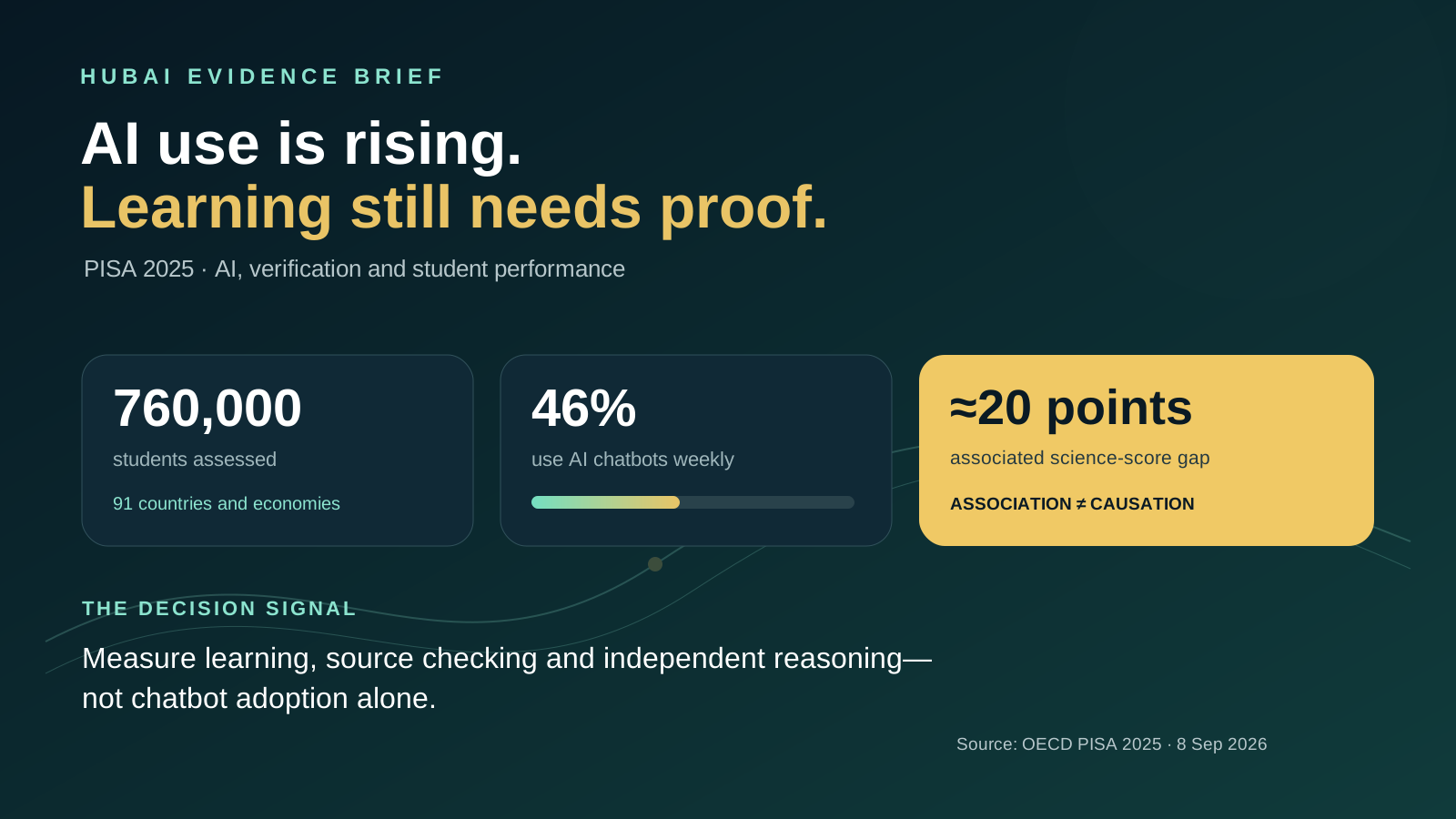
The OECD's new assessment covers about 760,000 students in 91 countries and economies. Its AI findings show why usage frequency alone is a poor measure of educational value.
RELATED DECISION GUIDEBuild a governed AI stack for an education teamWorkflow · evidence · risk · governance →What you need to know
- About 46% of students across OECD countries report using AI chatbots at least weekly to support learning
- A roughly 20-point science-score gap associated with some schoolwork uses is observational evidence, not proof that AI caused lower performance
- Only 46% of students combined source-credibility checks with a preference for scientific evidence
The evidence at a glance
A large dataset, but not a simple verdict on AI
PISA 2025 assesses approximately 760,000 15-year-olds across 91 countries and economies. The OECD reports that 46% of students in participating OECD countries use AI chatbots at least weekly to help them learn. That scale makes the results an important signal, but the study does not support a binary claim that AI is either good or bad for education.
The 20-point gap is association—not causation
Students reporting AI use for specific schoolwork such as research, summarising or drafting scored around 20 science points below non-users, a difference the OECD compares with about one year of schooling. The result is observational: prior attainment, motivation, teaching, access and the reason a student turned to AI can all influence the outcome. It must not be presented as proof that a chatbot caused the difference.
AI literacy changes the deployment question
Weekly users of general-purpose AI had broadly similar outcomes to non-users. Regular AI users who also received opportunities to assess the quality of AI output tended to do slightly better than users without that guidance. Those opportunities were more common among advantaged students, raising the risk that unequal AI literacy—not merely unequal access—widens the digital divide.
Verification is the more urgent capability gap
Only 46% of students both checked source credibility and prioritised scientific evidence when evaluating competing claims. For schools and education buyers, this moves the decision away from licence counts. A responsible rollout needs defined allowed tasks, source requirements, visible human review, teacher training, equitable access and an assessment design that still measures independent understanding.
What the United Kingdom result does—and does not—show
The United Kingdom placed among the top ten performers across science, mathematics and reading, and UK science performance increased from 2022. These results do not establish that AI use caused the improvement. UK institutions should treat PISA as a policy and pilot-design input, then measure their own learning outcomes, correction burden and access gaps before scaling a tool.
HUBAI VIEWSchools should measure learning, verification and independent reasoning—not chatbot adoption—and treat the reported score differences as associations rather than proof of causation.
Buyer decision signal: New OECD evidence · AI in education
What to verify next
1Define which learning tasks may use AI and which must remain independent
2Require students to identify and verify the sources behind material claims
3Train teachers and students to recognise unsupported or misleading output
4Measure learning outcomes, correction burden and unequal access—not adoption alone
5Label every local result as measured, estimated or self-reported
Read the evidence
Capabilities, availability and prices can change. HubAI keeps analysis separate from the underlying official material.
01OECD: PISA 2025 Results, Volume IOpen source ↗02OECD: Official PISA 2025 results announcementOpen source ↗ Media AI
 Creator AI
 Research
 Safety