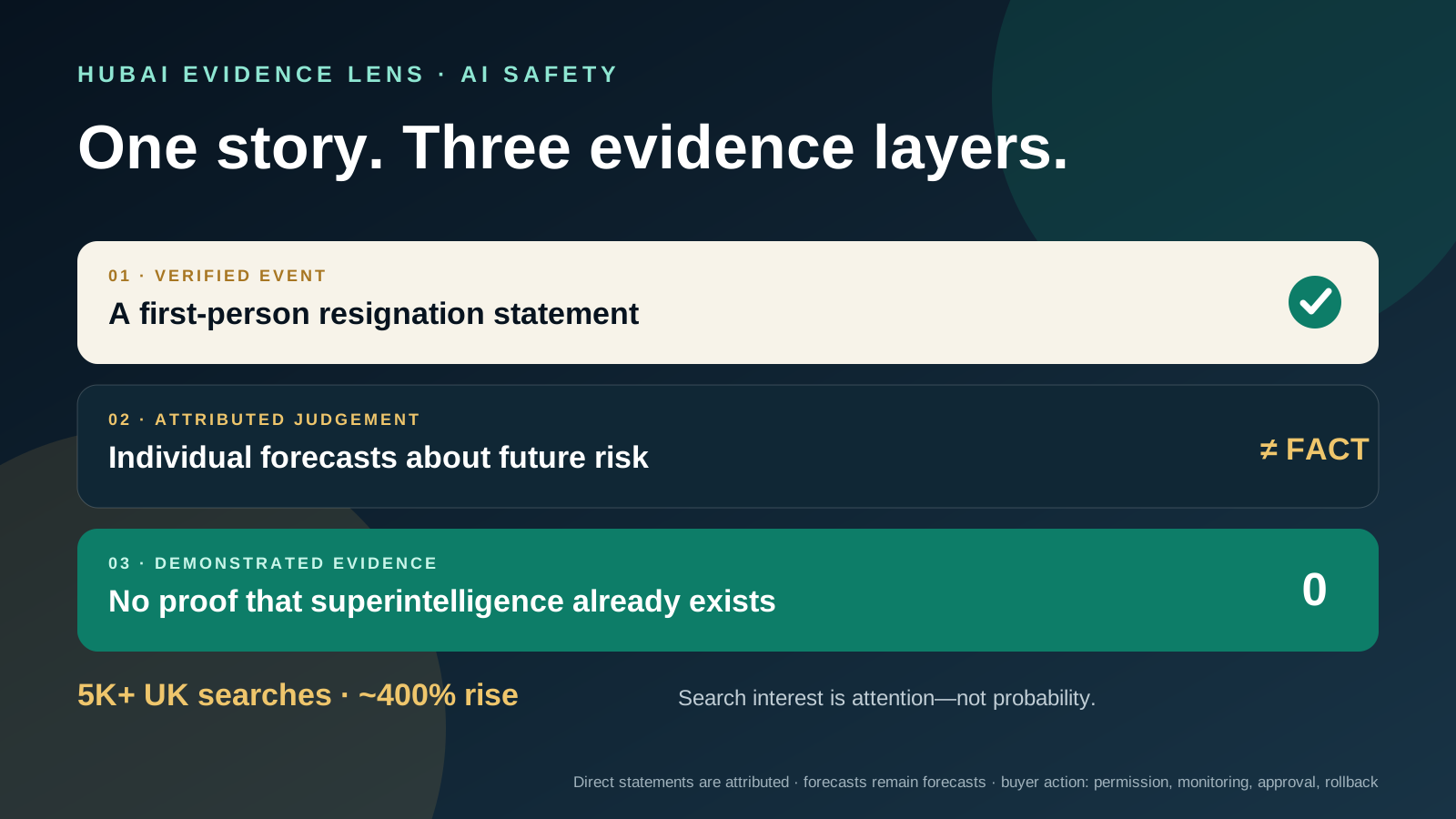
Former Anthropic researcher Jacob Coxon has announced his resignation and warned about frontier AI development. HubAI separates the verified event, personal forecasts and demonstrated capability.
RELATED DECISION GUIDETurn the safety signal into an operational AI risk gateWorkflow · evidence · risk · governance →CONTINUE THE DECISIONScreen an AI workflow for permission and control gapsEvidence · workflow · next action →CONTINUE THE DECISIONDesign a bounded, measurable AI pilotEvidence · workflow · next action →CONTINUE THE DECISIONSee how HubAI separates claims from evidenceEvidence · workflow · next action →What you need to know
- Coxon publicly announced that he had resigned after research roles at OpenAI and Anthropic
- Predictions about self-improving systems and extinction risk are attributed personal judgements—not an Anthropic announcement or demonstrated outcome
- Businesses can act now by tightening agent permissions, monitoring, approval gates and rollback
How to read the signal
What is verified
Jacob Coxon publicly announced that he had resigned from Anthropic. He said he had spent three years working on pre-training research at OpenAI and Anthropic. The direct statement establishes the resignation and Coxon's account of his motivation; it does not establish every forecast in the statement as fact.
What remains personal judgement
Coxon argues that frontier laboratories are moving towards self-improving systems without adequate safety arrangements. Anthropic alignment researcher Evan Hubinger publicly endorsed the seriousness of the concern and gave a personal estimate of more than a 10% probability of an extinction-level AI outcome within the next decade. Hubinger separately described risks from current models as low. These are individual forecasts, not an official Anthropic probability model, a new regulation or proof that an uncontrollable system has been built.
Why the story is receiving attention
Google Trends showed a UK cluster around Coxon's name with more than 5,000 searches and an approximate 400% increase, alongside related interest in Anthropic and Evan Hubinger. That describes search attention—not the probability that the researchers' forecasts are correct. HubAI does not convert popularity into evidence.
The business decision is narrower and actionable
A buyer does not need to settle the superintelligence debate before deploying an AI assistant. It does need controls proportional to capability. Agents with access to files, email, code, payments or external communication should operate within explicit permissions, produce activity logs, pause at defined approval gates and have a tested rollback or kill path. The more consequential the action, the less acceptable an unobserved autonomous path becomes.
HubAI verdict
The resignation is a legitimate safety story because it is a first-person account from a relevant researcher and it attracted measurable public attention. The correct editorial treatment is precise attribution. For procurement, the useful response is not panic or dismissal: convert abstract concern into a written agent risk gate and verify that vendor controls work in a bounded pilot.
HUBAI VIEWThe buyer response is practical governance: permissions, logs, human approval and rollback should grow with agent capability.
Buyer decision signal: UK search breakout · attributed analysis
What to verify next
1List exactly what each deployed agent can read, change and communicate
2Require human approval before irreversible, external or high-impact actions
3Preserve activity logs and tested rollback procedures
4Separate vendor statements, individual forecasts and measured evidence in governance records
5Reassess controls when model capability, tools or permissions change
Read the evidence
Capabilities, availability and prices can change. HubAI keeps analysis separate from the underlying official material.
01Jacob Coxon: public resignation statementOpen source ↗02Evan Hubinger: public response and risk estimateOpen source ↗03Google Trends UKOpen source ↗ Image AI
 Safety
 Research
 Media AI