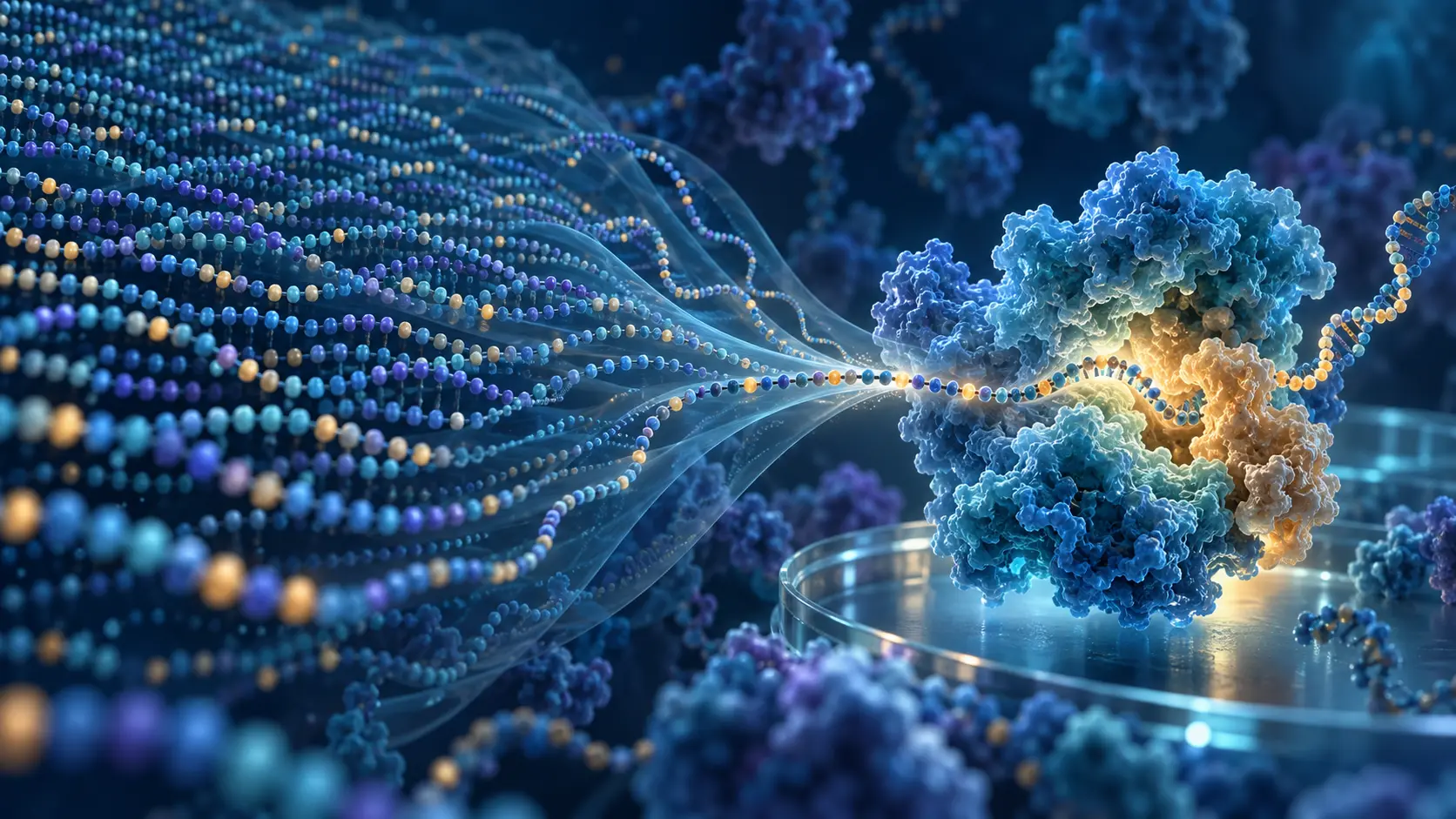
Anthropic says Claude agents identified an unusual reverse-transcriptase system beside repeating DNA arrays, then human scientists confirmed that the pattern exists in laboratory work. The system's biological function is not yet known and the supporting report is an early preprint.
RELATED DECISION GUIDEOpen the academic research AI decision deskWorkflow · evidence · risk · governance →CONTINUE THE DECISIONRun a reproducible same-task research model pilotEvidence · workflow · next action →CONTINUE THE DECISIONSet data, compute and approval boundariesEvidence · workflow · next action →CONTINUE THE DECISIONSee how HubAI separates early claims from validated evidenceEvidence · workflow · next action →CONTINUE THE DECISIONCompare the separate GPT-Rosalind life-sciences routeEvidence · workflow · next action →What you need to know
- Claude searched public DNA-sequence data and prioritised an unusual reverse-transcriptase system beside repeating non-coding DNA arrays
- Human scientists reviewed the candidate and ran the laboratory experiments; Anthropic says the system's primary function is still unknown
- The evidence is an Anthropic-authored preprint, not a peer-reviewed finding, medical product or demonstrated gene-editing system
Vendor-reported research pipeline
Short answer: a real candidate, not a finished discovery
Anthropic reported on 23 September 2026 that Claude agents found an unusual reverse-transcriptase system associated with regularly repeating DNA sequences in bacteriophages. Human scientists reviewed the output and ran laboratory work showing that the repeat array is expressed as short RNAs. The team calls the candidate array-associated reverse transcriptase, or ART. Its primary biological function is still unknown, so the result should not be described as a proven gene-editing mechanism, treatment or CRISPR replacement.
What Claude actually did
The researchers gave Claude a high-level prompt to search a large DNA-sequence database for unusual reverse transcriptases. Anthropic says roughly 950 agents spent 21 hours and 210 million tokens gathering more than 200,000 reverse transcriptases, proposing 3,500 candidate systems and narrowing those to 20 detailed reports. One agent noticed a repeat array next to an unusual reverse transcriptase and checked its spacing, genomic neighbourhood and prior literature before sending the candidate for human review.
Humans supplied the laboratory evidence
Claude did not run the physical experiments. Anthropic's scientists selected candidates, expressed proteins in standard laboratory strains and characterised the system biochemically and structurally. The company says its new Bay Area group works at BSL-1 and BSL-2 and does not handle pathogens capable of infecting humans. That human review and wet-lab step is central: the AI generated and filtered hypotheses, while scientists decided what merited testing and interpreted the evidence.
Why the CRISPR comparison needs restraint
The reported repeat-array layout resembles one structural feature of CRISPR systems, and other known programmable systems share combinations of similar characteristics. That resemblance is a research clue, not evidence that ART can cut, copy or paste DNA on command. Anthropic explicitly says further experiments are underway to determine how ART works. A headline that says Claude discovered a new CRISPR tool would therefore go beyond the demonstrated result.
The evidence is early and comes from the developer
The technical report is an Anthropic-authored preprint released alongside the announcement. It has not yet completed journal peer review, and the company built the model, the multi-agent harness and the laboratory producing the claim. The team cites an external comment from CRISPR researcher Feng Zhang describing the finding as intriguing and worthy of further investigation, but that comment is not an independent replication. Sequence, analysis and laboratory methods must be scrutinised and reproduced before stronger conclusions are justified.
What research teams should measure
A buyer or laboratory should not evaluate this workflow by the number of agents or tokens alone. Freeze a real discovery task and compare candidate novelty, known-result recovery, false positives, expert triage time, compute and model cost, provenance, reproducibility and the share of candidates that survive laboratory validation. Record database versions, prompts, code, exclusions and every human decision. Sensitive or licensed data also requires explicit access, retention and network controls.
HubAI buyer verdict
The report is meaningful evidence that a general AI system can contribute to a tightly scoped genomics search when paired with specialist data, a multi-agent harness, expert selection and a physical lab. It is not a general proof that Claude autonomously does science, and it is not enough to rank or score Claude for research purchasing. Put the workflow on an academic shortlist only if the institution can reproduce the analysis, quantify false discoveries and fund qualified human and laboratory validation.
Evidence limits and editorial disclosure
Independent editorial coverage; not sponsored. Pipeline counts, timing, token use, candidate numbers and biological claims are attributed to Anthropic and its preprint. HubAI has not reproduced the computational search or laboratory work. The visible UK Google Trends first 25 contained no directly related AI or genomics query during this review, so no search-volume or breakout claim is made. The cover is an original conceptual illustration, not a micrograph, product interface or experimental result.
HUBAI VIEWThis is credible evidence of AI-assisted hypothesis generation in a bounded genomics workflow—not proof of a new gene-editing tool, autonomous science or a deployable medical product.
Buyer decision signal: Vendor preprint · function and peer review pending
What to verify next
1Read the technical report and separate computational observations from laboratory measurements
2Confirm the exact dataset versions, search space, prompts, code, models and agent harness
3Measure known-result recovery, novelty, false positives and expert triage time on a frozen task
4Require reproducible artifacts, provenance and a record of every human selection decision
5Budget model tokens, compute, database access, qualified review and laboratory validation together
6Check data licences, retention, network access and institutional biosafety requirements
7Do not use the result for clinical, diagnostic or gene-editing decisions without independent evidence
Read the evidence
Capabilities, availability and prices can change. HubAI keeps analysis separate from the underlying official material.
01Anthropic: Claude discovers a novel enzyme system with CRISPR-like repeats — 23 September 2026Open source ↗02Anthropic technical preprint: Array-associated reverse transcriptasesOpen source ↗03Claude Science documentation: provenance, sandboxing and research-use limitsOpen source ↗ Research
 Research
 Business
 Business