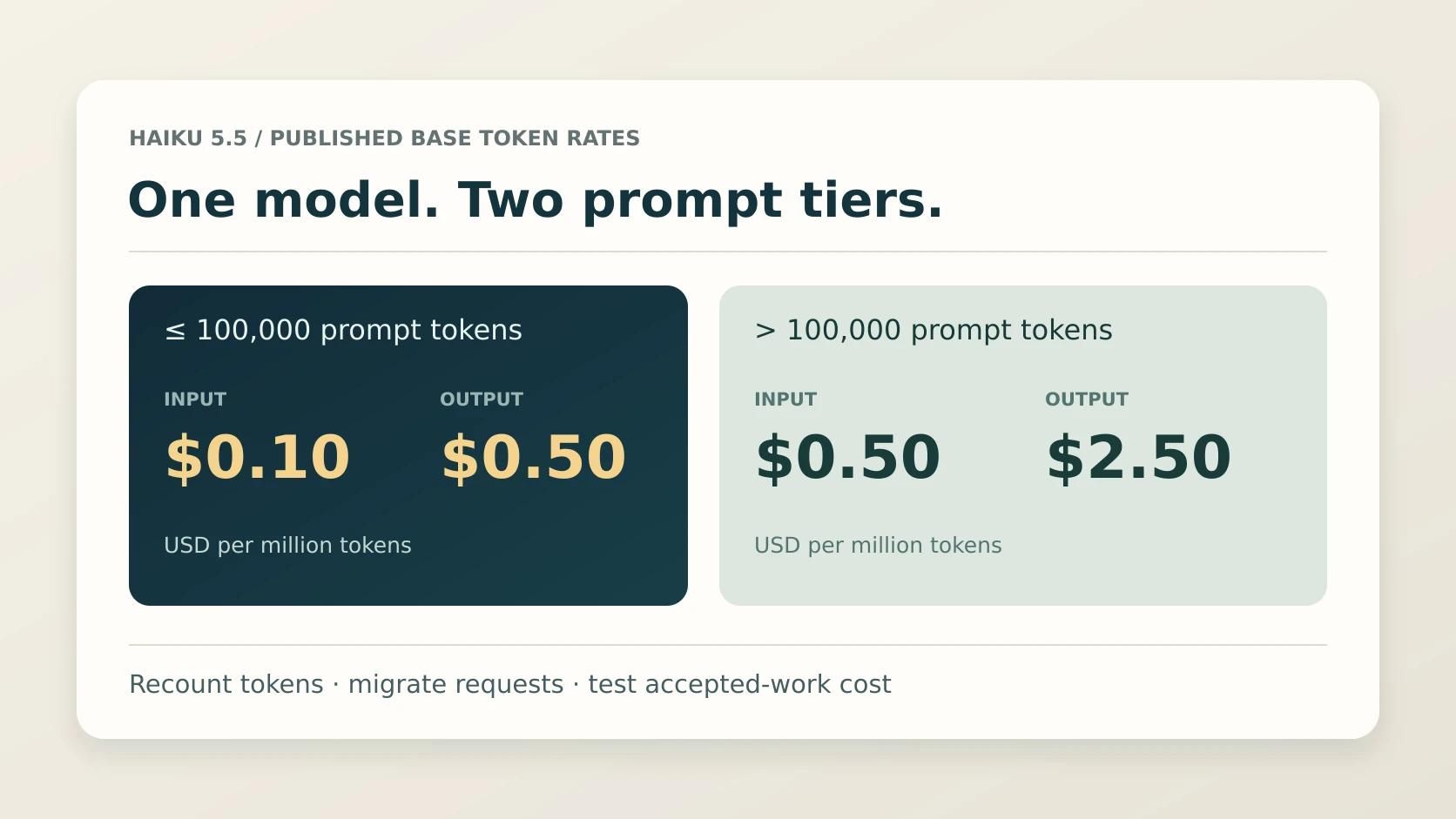
Anthropic released claude-haiku-5-5 on 7 October. Published base rates start at $0.10 input and $0.50 output per million tokens, rising to $0.50/$2.50 for prompts above 100,000 tokens. Sonnet 5.5 cache reads are now $0.10/M; Max and Team API credits have separate eligibility and usage rules.
RELATED BUYER PROFILEReview Haiku pricing, migration and test-pending evidencePricing · access · strengths · limitations →RELATED DECISION GUIDEPlan a same-work model migrationWorkflow · evidence · risk · governance →CONTINUE THE DECISIONBudget accepted-task costEvidence · workflow · next action →CONTINUE THE DECISIONReview tool and data controlsEvidence · workflow · next action →CONTINUE THE DECISIONCheck the updated Sonnet profileEvidence · workflow · next action →CONTINUE THE DECISIONCompare a volume-model candidate and an escalation routeEvidence · workflow · next action →What you need to know
- claude-haiku-5-5 launched 7 October; independent Test pending
- Prompt length determines the $0.10/$0.50 or $0.50/$2.50 base rate pair
- Legacy thinking, sampling and tool assumptions can break requests
- Subscription API credits require eligibility and a linked Console organisation
Short answer: a cheaper small-model route with a threshold
Claude Haiku 5.5 is a new API model for bounded, repeated work. The 7 October launch adds a different commercial and migration decision from the existing Sonnet and Opus stories. Its advertised speed and capability are supplier claims; HubAI has not reproduced them. Choose a controlled extraction, routing or summary job before considering a wider deployment.
Verified rates: prompt length changes the bill
The Claude Platform lists USD rates per million tokens. For prompts up to 100,000 tokens, input is $0.10, output $0.50, cache reads $0.01 and five-minute cache writes $0.125. Above 100,000 prompt tokens the listed rates are $0.50, $2.50, $0.05 and $0.625 respectively. These are token rates, not fixed job prices. Check the full pricing rules, cloud invoice route, taxes, tools, retries and reviewer time.
Why it matters: route the narrow work, not every task
A small-model candidate can handle a labelled queue while a larger model takes unresolved cases. HubAI analysis: the useful buying measure is accepted results per complete cost, not the cheapest token. Include ambiguous cases, malformed outputs and escalation in the pilot. A summary that drops a critical exception can cost more to correct than the token saving.
Verified model and access limits
The official overview lists claude-haiku-5-5, a one-million-token context, up to 128K standard output and adaptive thinking with medium default effort. Anthropic lists Claude API, AWS, Google Cloud and Microsoft routes; account provisioning and regional terms need checking. UK entitlement, a UK residency guarantee and an unmetered free trial have not been independently established.
Migration: a model-name swap is not enough
The migration guide requires recounting tokens and replacing budget-based enabled thinking with adaptive thinking. Select response blocks by type. Remove legacy sampling controls and assistant prefill; invalid values can return 400 errors. Computer-use integrations need the newer toolset on the specified routes. Keep earlier conversation content unchanged and preserve the producing account when replaying thinking blocks. Handle refusals; do not assume server-side fallback or Haiku Priority Tier capacity.
Sonnet cache reads and subscription credits are separate changes
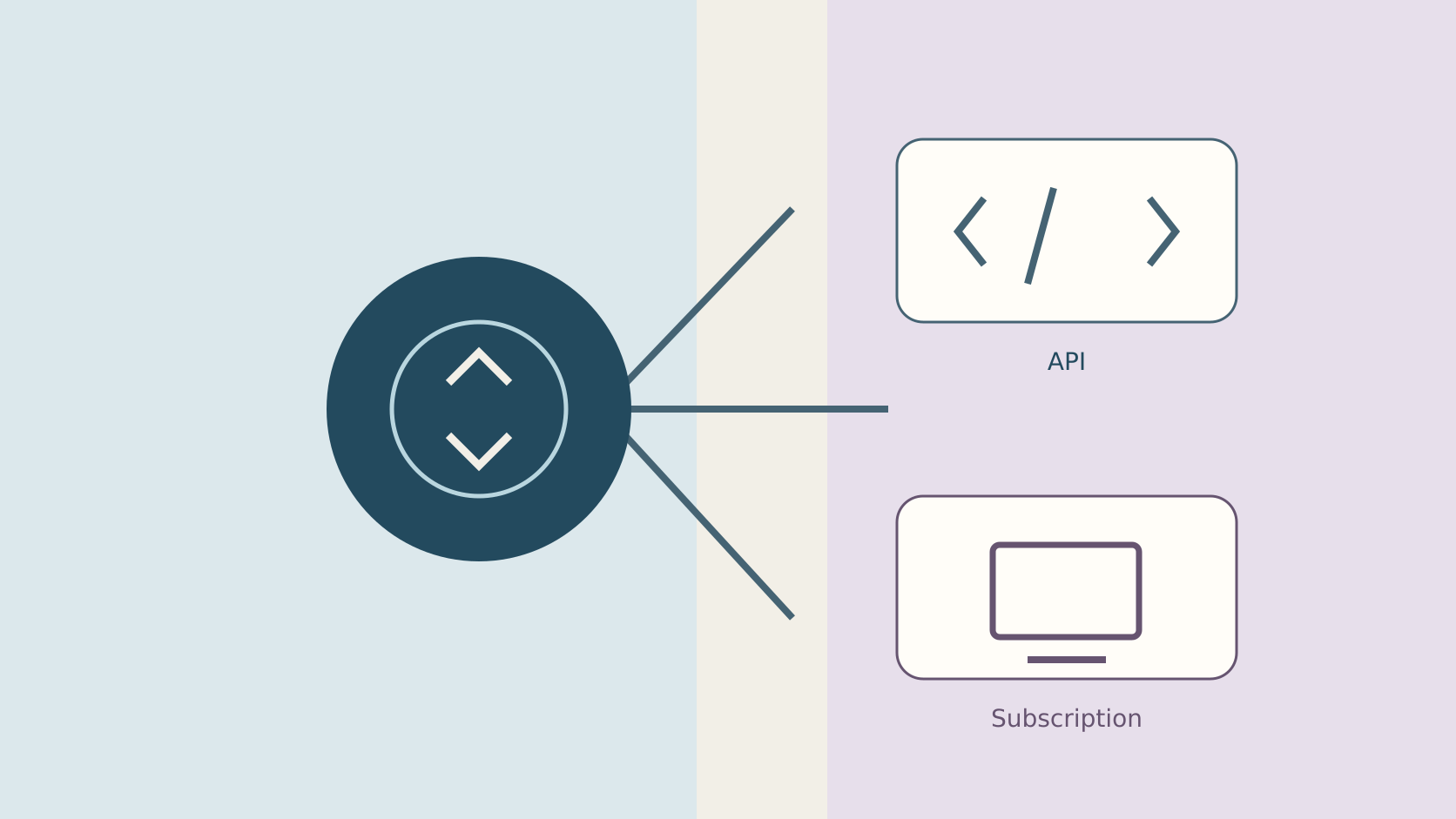
Sonnet 5.5 cache reads drop from $0.20 to $0.10 per million tokens. This does not halve its input or output price or guarantee a fixed saving on a whole task. Max 5x and 20x monthly API credits are $100 and $200. Team credits are $20 per Standard seat and $100 per Premium seat, pooled with a $500 cap. The offer rolls out over several days and requires seven days on an eligible plan plus linking one Console organisation.
Do not treat credits as unlimited Claude usage
The help page says unused credits expire each billing cycle. They do not increase interactive Claude, Code or Cowork limits and do not apply to partner-cloud usage. Purchased credits or auto-reload can continue spending after the allowance; otherwise requests stop. HubAI analysis: check the linked organisation, authorised API-key holders and spend controls before treating the allowance as a pilot budget.
HubAI buyer verdict
Use Haiku 5.5 as a candidate for narrow, high-volume work when it passes the same acceptance rules as the existing model. Freeze representative inputs on both sides of the pricing threshold, pin effort and tools, and record accepted outputs, exceptions, retries, review minutes and billed cost. Compare against your existing route and Sonnet only where their tasks overlap. Test pending: no independent HubAI Score or benchmark winner is assigned.
Evidence and disclosure
Independent editorial coverage; not sponsored. Prices and model behaviour come from Anthropic documentation checked on 8 October 2026. The proposed pilot is HubAI analysis, not a completed test. No directly relevant query appeared in the accessible first 25 of 174 UK Trending Now entries; no story-specific search volume is asserted. The original infographic shows published base token rates, not measured task cost or a performance ranking.
HUBAI VIEWPilot one bounded classification or extraction workload. Check token counts and request compatibility before projecting savings or swapping production traffic.
Buyer decision signal: Model launch · tiered API rates and breaking changes
What to verify next
1Pin the account route, model ID, tools and effort
2Recount the actual prompt on both sides of 100,000 tokens
3Check adaptive thinking, blocks, sampling and prefill migration
4Confirm UK provisioning, retention and residency terms
5Set an API spending ceiling and audit linked credit users
6Compare accepted outputs, retries, reviewer effort and complete billed cost
Read the evidence
Capabilities, availability and prices can change. HubAI keeps analysis separate from the underlying official material.
01Anthropic launch — 7 October 2026Open source ↗02Claude Haiku 5.5 model overviewOpen source ↗03Claude Platform USD pricingOpen source ↗04Haiku 5.5 migration guideOpen source ↗05Max and Team API-credit eligibility and exclusionsOpen source ↗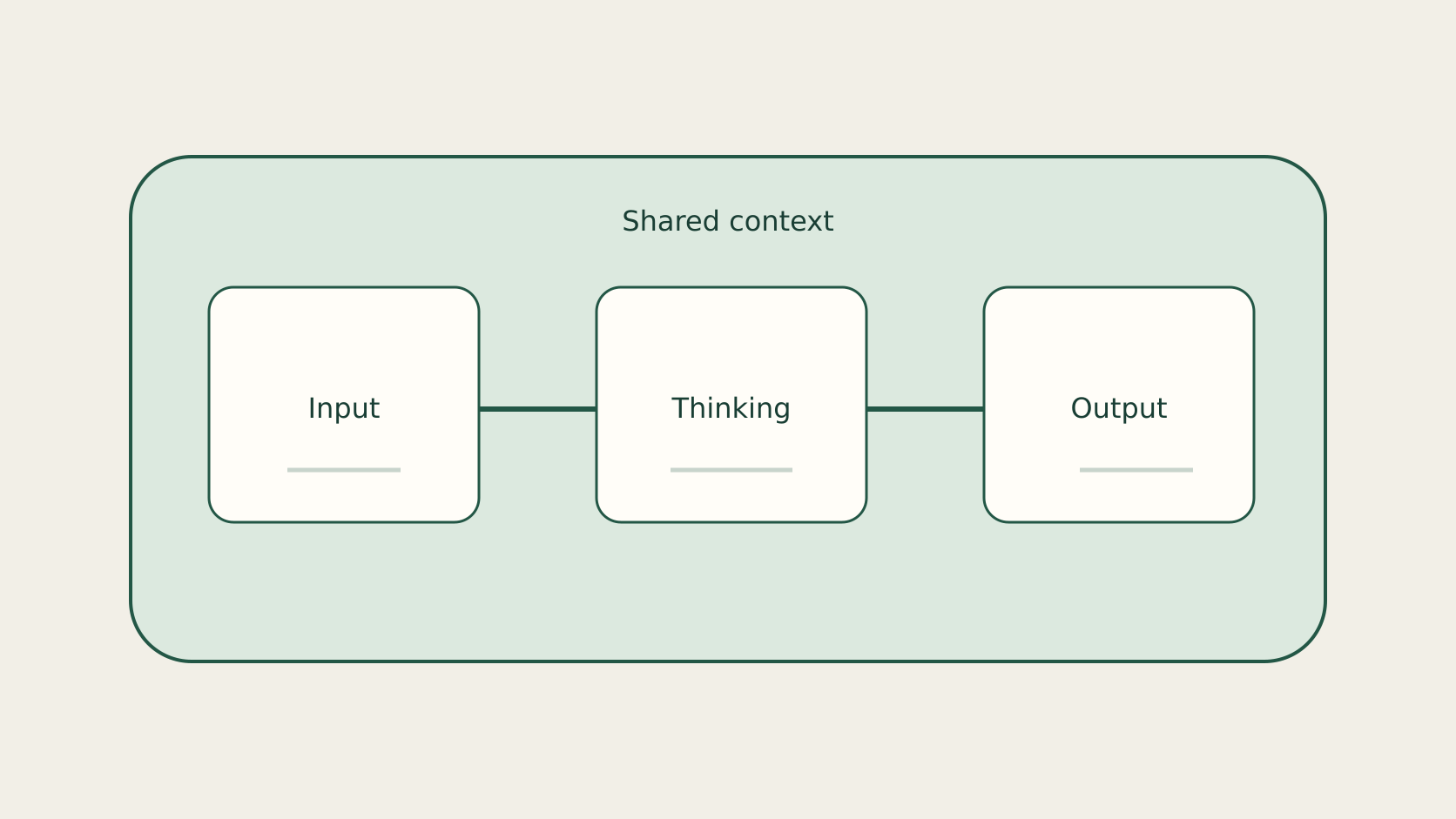 Models
 Models
 Models
 Models