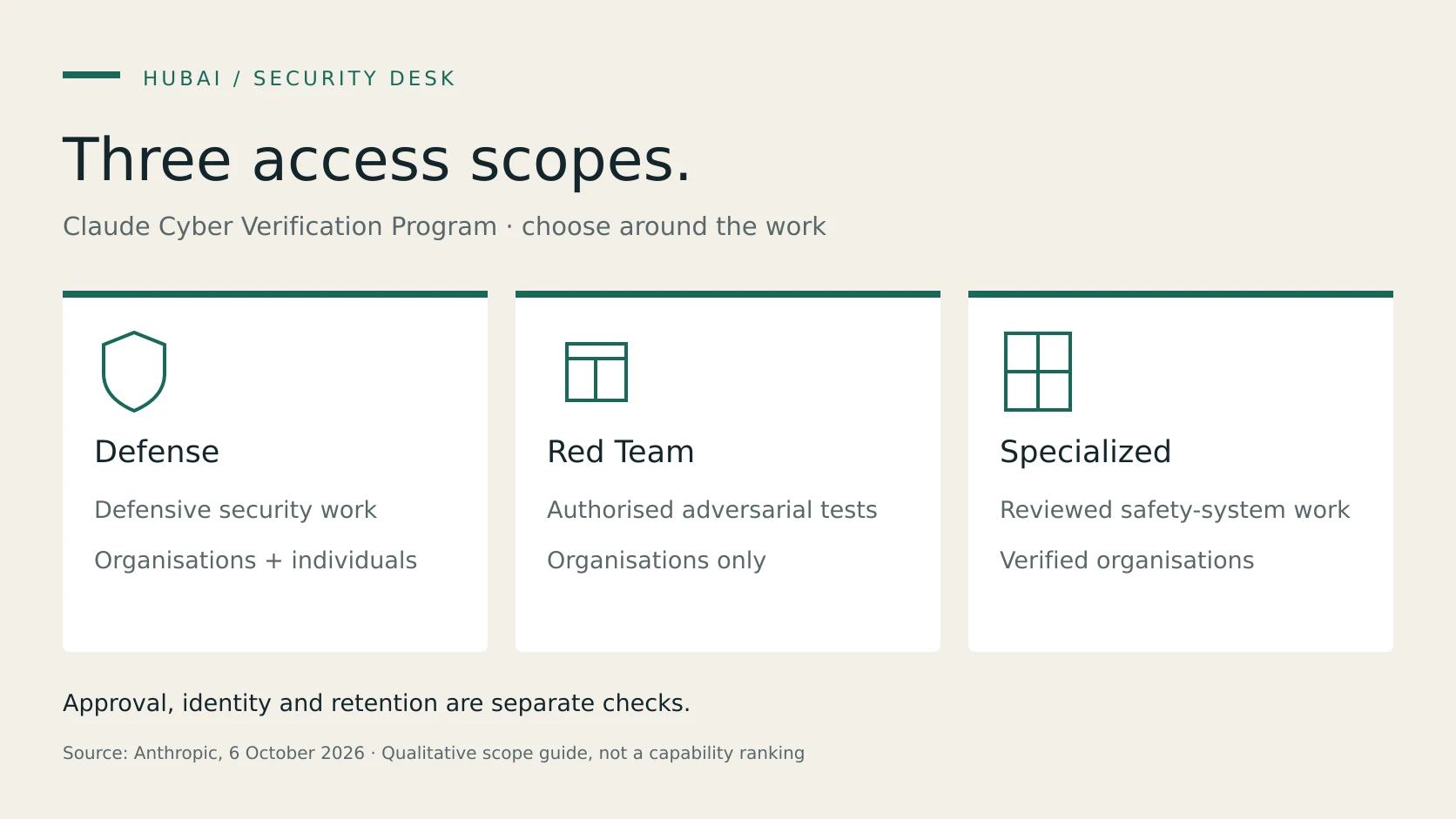
Anthropic's expanded Cyber Verification Program offers Defense, Red Team and Specialized Access. Approval, permitted targets, credentials and data retention determine what a security team can actually deploy.
RELATED BUYER PROFILEReview Mythos 5.1 access, model rates and test-pending evidencePricing · access · strengths · limitations →RELATED DECISION GUIDEDefine authorised targets, identities and data boundariesWorkflow · evidence · risk · governance →CONTINUE THE DECISIONVerify admission, retention and route-specific termsEvidence · workflow · next action →CONTINUE THE DECISIONPlan one bounded defensive security pilotEvidence · workflow · next action →CONTINUE THE DECISIONCount model usage, controls and analyst reviewEvidence · workflow · next action →CONTINUE THE DECISIONSeparate the EFS rollout plan from today's access grantEvidence · workflow · next action →What you need to know
- Defense Access permits defensive security work; Red Team Access adds authorised adversarial testing
- Specialized Access remains limited to verified organisations; individual applicants can use Defense Access only
- Defense Access has a 15 December 2026 deadline for phishing-resistant MFA and migration away from static credentials
- Data retention is normally required; individual grants do not offer zero data retention
Short answer: wider application access, with a defined scope
Anthropic announced its expanded Cyber Verification Program on 6 October. It combines the previous CVP and Project Glasswing arrangements into Defense Access, Red Team Access and Specialized Access. The programme covers Opus 5.5, Sonnet 5.5 and Mythos 5.1. This is a verification and control change, not a new model release or unrestricted access. Existing members retain their current terms while transitioning.
Why it matters for a security team
A model subscription alone does not establish permission to perform every security task. A tier can change which work is interrupted, while also adding obligations to the organisation operating it. Before procurement, map one real workflow to its authorised targets, named operators, retained information and recovery plan. A lower refusal rate is not evidence that an agent will find valid vulnerabilities or act safely on your infrastructure.
Choose the narrowest tier that covers the work
Defense Access covers work such as incident response, malware analysis and vulnerability validation. Red Team Access adds penetration testing on systems the organisation is authorised to test; actions capable of physical harm or mass disruption remain blocked. Individuals are eligible only for Defense Access. Specialized Access addresses particularly sensitive safety systems and involves deeper organisation review with the US government. Do not treat the three tiers as a quality ranking or an entitlement to test someone else's systems.
Prepare identity controls before 15 December
Anthropic's security requirements give Defense Access users until 15 December 2026 to adopt phishing-resistant MFA and move away from static credentials. Until then, MFA is required and interim API keys must be assigned, kept out of source code, stored securely and replaced at least every seven days. Red Team Access already requires short-lived credentials, phishing-resistant MFA and organisation accounts. Teams also need a named security contact and procedures for reporting incidents. These are programme conditions, not a claim that compliance with them satisfies every UK legal obligation.
Retention needs its own approval
CVP normally requires retention for misuse monitoring. Some existing organisations with a Fable or Mythos retention exemption can use CVP with zero data retention during the transition. Individual grants explicitly retain and monitor traffic and do not offer zero data retention. Enterprise Frontier Safeguards is a planned route for eligible organisations to hold monitoring data in customer-controlled cloud infrastructure; it should not be treated as universally deployed today. Request the actual retention duration, reviewers, region and contractual terms before uploading incident material.
Apply once, then verify the route
The official portal accepts one application per organisation; administrators provision approved users. Individuals apply separately for Defense Access on a paid plan. Cloud accounts and supported third-party platforms have different linking and provisioning steps, and Specialized Access is unavailable through third-party platforms. UK buyers should verify country, account, cloud route and model entitlement with Anthropic: the announcement does not establish automatic UK admission. An access grant is not a monetary grant, free model usage or approval to build a client-facing security product.
Model price and programme access are separate
Anthropic's Mythos 5.1 model documentation publishes the API identifier claude-mythos-5-1 and base prices of $10 per million input tokens and $50 per million output tokens. Those are model rates, not a published all-in CVP price or proof that a UK account can call the model. The current model overview describes verification-based access, consistent with the expanded CVP route. Confirm the specific grant and billing terms rather than treating the model rate card as an access entitlement.
HubAI buyer verdict
Prepare an application if ordinary model safeguards interrupt legitimate security work, but begin with a tightly scoped defensive pilot. Freeze an authorised task set and compare valid findings, false positives, analyst review, interruptions, credential recovery and complete billed cost with your existing tools. Keep offensive actions behind explicit approval and an independently enforced network boundary. Do not upgrade solely to remove blocks. Mythos remains Test pending: HubAI has not completed an independent same-task evaluation and assigns no score.
Evidence limits and editorial disclosure
Independent editorial coverage; not sponsored. Programme and model descriptions come from Anthropic. Its tier evaluation is a vendor test, not independent proof of operational safety; HubAI does not repeat it as a safety score. The accessible first 25 UK Google Trends entries contained no directly related query, so no search volume or breakout is claimed. The original cover is a qualitative guide to three access scopes, not a benchmark, certification mark or product interface.
HUBAI VIEWApply for the narrowest suitable tier, establish the retention terms and prepare identity controls before connecting sensitive systems. Approval is not a safety certificate or blanket UK availability.
Buyer decision signal: Verified-access update · three tiers and new identity requirements
What to verify next
1Document authorised systems, permitted actions and the narrowest suitable tier
2Confirm UK account eligibility, model entitlement and cloud provisioning
3Prepare phishing-resistant MFA, short-lived identities and credential revocation
4Record retention duration, human reviewers, region and any actual exemption
5Assign a security contact and incident-reporting owner
6Check separate productization permission before offering a client-facing service
7Measure accepted findings, analyst review, failures and complete pilot cost
Read the evidence
Capabilities, availability and prices can change. HubAI keeps analysis separate from the underlying official material.
01Anthropic: expanded CVP — 6 October 2026Open source ↗02Claude Help: application, provisioning and retentionOpen source ↗03Claude Help: tier-specific security requirementsOpen source ↗04Claude Platform: Mythos 5.1 identifier and published model ratesOpen source ↗05Anthropic: Enterprise Frontier Safeguards rollout planOpen source ↗06Anthropic: official CVP application portalOpen source ↗ Safety
 Safety
 Safety
 Safety