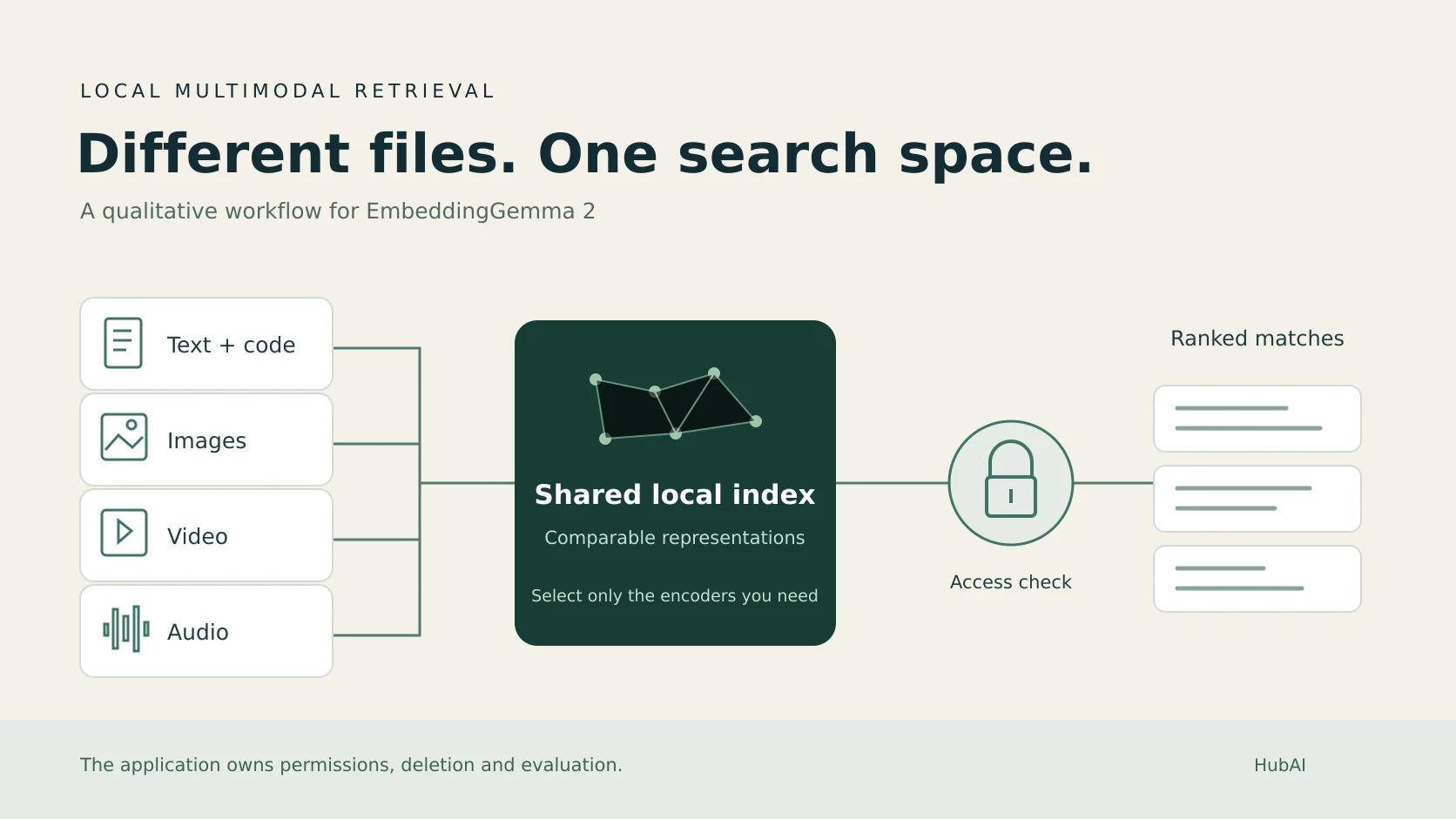
Google has released EmbeddingGemma 2 under Apache 2.0 for search across text, code, images, video and audio. Downloadable weights are available; the announced Android ML Kit service is still planned. Local deployment leaves permissions, retrieval quality and operating cost with the developer.
RELATED BUYER PROFILEReview EmbeddingGemma 2 access, licence and test-pending evidencePricing · access · strengths · limitations →RELATED DECISION GUIDEDefine a same-collection retrieval pilotWorkflow · evidence · risk · governance →CONTINUE THE DECISIONReview index permissions and local data flowsEvidence · workflow · next action →CONTINUE THE DECISIONCount indexing, storage and review costsEvidence · workflow · next action →CONTINUE THE DECISIONChoose a practical developer workflowEvidence · workflow · next action →What you need to know
- Downloadable weights under Apache 2.0; model identity google/embeddinggemma-2
- A modular embedding model for retrieval across text, code, images, video and audio
- Android ML Kit service is planned for the coming weeks, not confirmed available today
- Local inference leaves access controls, deletion and application data flows with the developer
Short answer: a retrieval model you can run locally
Google released EmbeddingGemma 2 on 6 October. It turns text, code, images, video and audio into comparable numerical representations, allowing an application to retrieve related material across those formats. The weights are published under Apache 2.0. It is an embedding component, not a chatbot that writes an answer or a finished enterprise search service. The new choice is whether your own application should build and operate a local multimodal index.
Why a buyer should care
A field team could search approved manuals and photographs without sending every query to a hosted model. A newsroom could find a clip from a description; a developer could retrieve relevant code and diagrams together. Those are potential workflows, not measured HubAI outcomes. The useful decision is whether local retrieval solves a specific network, data-handling or search problem better than the current workflow. Adding modalities to a working text index without a demonstrated need can add ingestion and review work.
One checkpoint, only the encoders you need
Google documents the checkpoint as google/embeddinggemma-2. Text and code use a 270M-parameter configuration; vision and audio modules bring the complete model to 740M. Outputs share a 768-dimensional space and can be shortened to 512, 256 or 128 dimensions. The developer guide requires matching dimensions for queries and indexed items. Start with the collection you actually have. A smaller vector is a storage option, not evidence that retrieval quality will be unchanged.
Downloaded weights now; ML Kit later
The downloadable model and developer examples are the current route. Google AI Edge provides local retrieval showcases and a browser demo. Its 6 October post says the Android ML Kit service is coming in the following weeks. Do not schedule a production launch around an undated future service. UK teams should confirm the chosen download, application-store and runtime route; HubAI has not performed a UK installation or measured a target device. No UK hosted API price or automatic store availability is asserted here.
Price means operating cost, not a token rate
Apache 2.0 provides a no-charge licence subject to its terms; the model launch does not publish a hosted API token rate for this route. Budget compute, storage, media processing, initial indexing, incremental updates, backups, dependency maintenance and human evaluation. A local device still has memory, battery and support constraints. Retain the required licence and notices when distributing a derived package. The licence does not provide rights to the documents, recordings or images placed in the index.
Offline inference is not a privacy certificate
Google positions the model for on-device and offline use. That can support a local data boundary, but the surrounding application decides what leaves the device. Inspect telemetry, downloads, backups, diagnostic logs and any separate answer-generation model. Restrict retrieval to material the current user may access before returning matches or passing them to a generator. Test deletion from the source and the derived index, including cached results. An embedding vector should not be assumed to anonymise sensitive source content.
A model card is the starting point for testing
Google warns that quality can vary by language, domain and task instructions. Its benchmark tables and device measurements are supplier results; HubAI has not reproduced them. Use representative UK terminology, accents, document layouts and code conventions in your own evaluation. Check whether short video samples miss the decisive moment and whether a similar-looking document is actually the correct one. Similarity finds candidates; it does not verify a claim or establish that a retrieved instruction is safe.
HubAI buyer verdict
Pilot this if local access to a mixed-format collection is a real requirement. Keep your existing search as a baseline and freeze the source snapshot, permissions and labelled queries. Record relevant items in the first results, missed evidence, wrong-user results, indexing time, warm and cold query latency, storage, device behaviour and reviewer effort. Include misleading matches, denied documents, deleted files and unsupported questions. Keep answer generation separate so a fluent answer cannot hide poor retrieval. Test pending: no independent same-task HubAI Score has been assigned.
Evidence and editorial disclosure
Independent editorial coverage; not sponsored. Model specifications, release terms and integration plans are attributed to Google. The buyer test plan is HubAI analysis, not a completed benchmark. No related AI query appeared in the accessible first 25 of 276 UK Trending Now entries; this is not a whole-corpus finding or a search-volume claim. The original cover explains a qualitative retrieval workflow and does not show a product interface or measured performance.
HUBAI VIEWStart with one permission-filtered collection, load only its required encoders and measure useful retrieval on your actual devices before replacing an existing search service.
Buyer decision signal: Open-weight launch · local multimodal retrieval
What to verify next
1Choose one collection and identify who may retrieve each item
2Pin the checkpoint, runtime, encoder selection and vector dimensions
3Confirm the UK download or store route on the intended devices
4Review licence notices and separate rights to indexed content
5Inspect telemetry, backups, deletion and any cloud generation step
6Compare labelled retrieval results with the current search baseline
7Record indexing, latency, storage, review effort and complete operating cost
Read the evidence
Capabilities, availability and prices can change. HubAI keeps analysis separate from the underlying official material.
01Google DeepMind: EmbeddingGemma 2 launch — 6 October 2026Open source ↗02Google: developer guide, checkpoint and encoder configurationsOpen source ↗03Google model card: intended use, specifications and limitationsOpen source ↗04Google AI Edge: local demos and planned ML Kit serviceOpen source ↗05Google developer documentation: EmbeddingGemma and previous versionOpen source ↗06Google: Apache 2.0 model licenceOpen source ↗07Google AI Edge: official browser retrieval demoOpen source ↗ Models
 Models
 Models
 Models